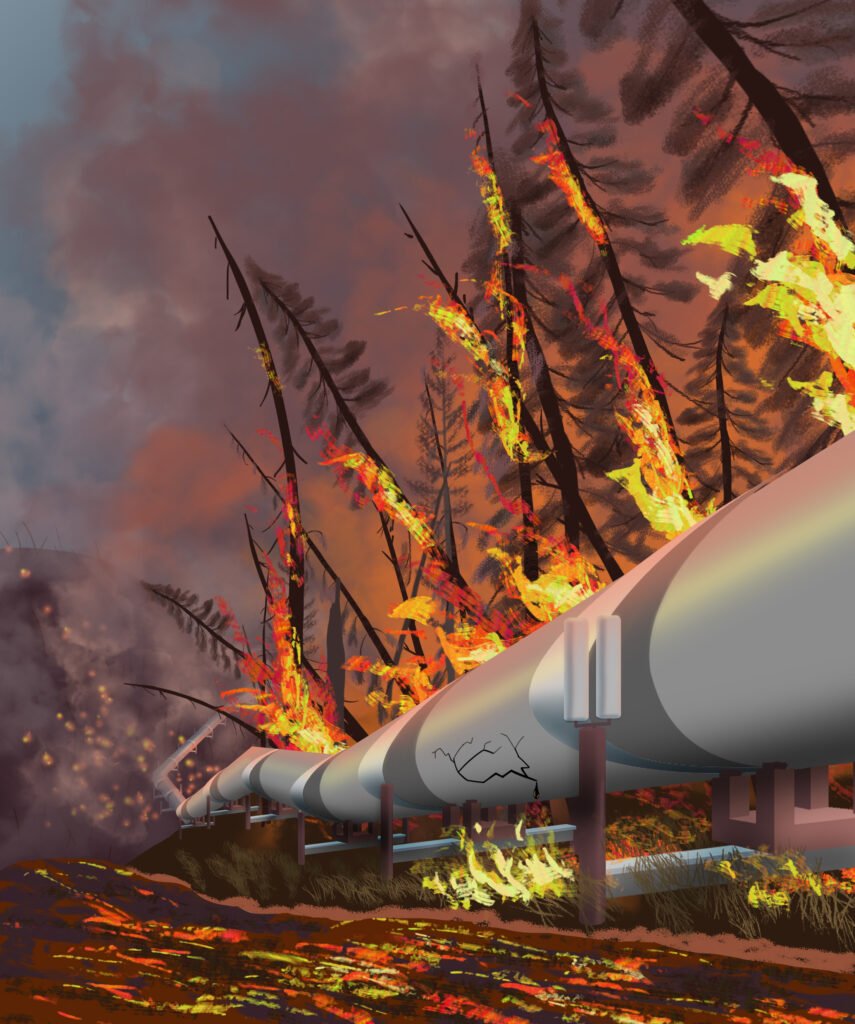
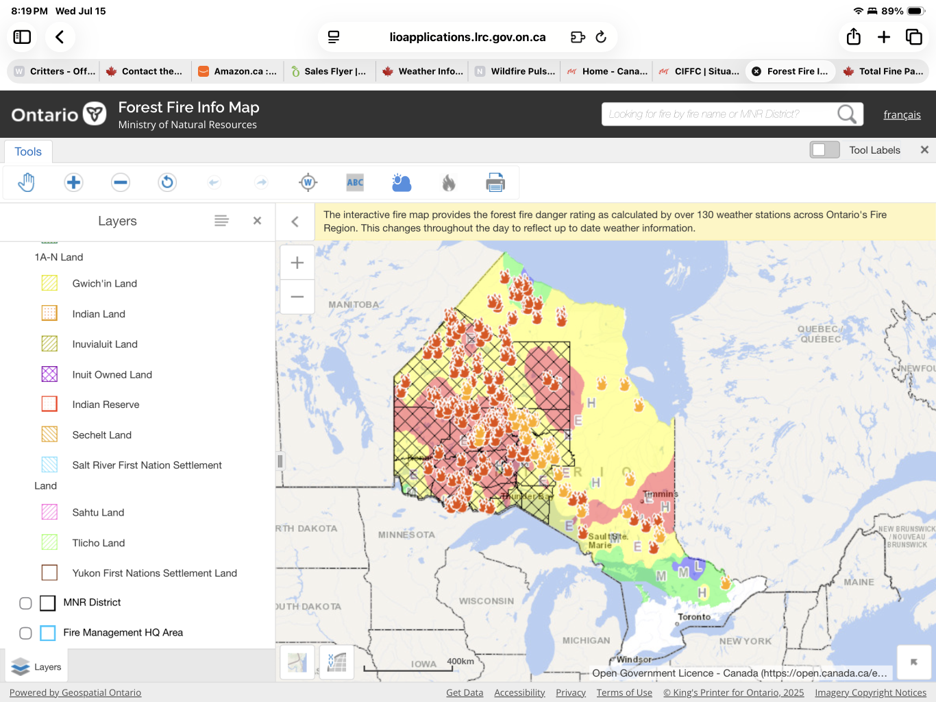
The news yesterday had an awe-inspiring and scary video of CN Rail workers on a train that is closely surrounded by a raging wildfire. I was extremely glad to hear that the crew was able to escape safely, but I find myself haunted by those images. This train was in Northern Ontario, through which Prime Minister Mark Carney has just announced plans to lay an oil pipeline linking Ontario to the West Coast. I looked at the map of wildland fires that are currently burning. It is difficult to envision a route through Northern Ontario that would avoid the danger of wildfires. I am now extremely concerned about how prepared Canada, and Ontario in particular, is for the dangers of running an oil pipeline through Northern Ontario, and the additional technology and firefighting.
I looked at the map of wildland fires that are currently burning. It is difficult to envision a route through Northern Ontario that would avoid the danger of wildfires. I am now extremely concerned about how prepared Canada, and Ontario in particular, is for the dangers of running an oil pipeline through Northern Ontario, and the additional technology and firefighting resources that will be essential to protect the proposed pipeline.
Wildfires have been increasing in number. According to the Province of Ontario the number of wildfires year to date in 2026 is 483. In 2025 the number of fires year to date was 351. Both numbers are higher than the ten-year average of 320.
The only research on the topic of wildfires and oil pipelines that I was able to easily locate, as a member of the general public, was about the recovery of the oil and gas industry after wildfires. I could not locate any research about the critical topic of how to protect pipelines from wildfires.
If the pipeline is shut down during a fire, there is still a residual amount of fuel inside the pipes that could ignite, together with minor leakages. Even if a pipeline survives a fire intact, how have the structure and joints been affected? How fire-hardened are pumps and control stations along the route? Even buried pipelines can be subjected to zombie fires, which burn undetected underground for months during the winter.
The government and industry experts, together with fire safety experts, need to determine what extra firefighting resources will be required to ensure the safe operation of the proposed pipeline through remote areas that are difficult to reach for fire suppression crews. We are currently at fire readiness level 4, and July is not half over. How will resources be allocated at times when our fire readiness reaches level 5? This is the level where all firefighting resources are in use, and international aid has been requested.
Just as important is the question: who is going to pay for the extra personnel and equipment required to control the fires? According to Natural Resources Canada, the current number of active fires in Canada is 843, with 556 only being monitored, as of July 15. Of the fires being actively fought, 103 are out of control.
According to the Ontario Forest Fire Info website, Ontario currently has 161 wildfires as of July 15, 2026:
| Under Control | 7 |
| Being Held | 7 |
| Not Under Control | 56 |
| Being Observed | 91 |
| Total Ontario Wildfires | 161 |
This is not even taking into account the number of wildfires that are caused by pipelines that leak and corrode as they age. In order to avoid causing fires, pipelines must be able to withstand extreme temperatures in both winter and summer, and those extremes are widening. Extreme weather events are increasing. Tornado alley is moving east, and is pointing weather events north towards the more heavily populated areas of Southern Ontario. Ontario is more geologically stable than the West Coast, but is still subject to the occasional minor earthquake. If joints and seals have been hardened or cracked by extreme temperature variations, they can still be a matter for concern, especially if there are any fracking operations in the areas near the projected route of the pipeline.
Pipeline explosions, while unusual, still occasionally happen, especially as pipeline infrastructure ages. Pipelines that run through wildfire territory will be even more at risk from such events. The government must allocate funding to researchers so that they can determine how quickly the pipelines will degrade under these conditions and search for better materials. Post-fire inspections by the government should be mandatory.
In the meantime, legislators need to regulate fire prevention and suppression technology along the entire pipeline. This technology and the pipelines must be properly secured against physical and electronic attacks from malign foreign actors, which requires funding. Considering the severity of the risks from wildfires, it might be worth considering locating the pipeline underwater in the Great Lakes where possible.
When one considers the hurdles to overcome before an oil pipeline can safely and reliably operate in wildfire territory, it is important for regulators to avoid fast-tracking a project like this. Operating in wildfire country will greatly increase the operating costs. We, the taxpayers, should not be left to cover all the additional firefighting personnel, especially when pipelines increase the risk of wildfires. We need to ask the question: Could such a project be financially viable, and more importantly, could it ever be safe?